
Catholicism in the Philippines: History, Traditions, and Cultural Influence

Faith at the Heart of Filipino Life

Catholicism in the Philippines is more than a religion—it is a defining element of national identity and cultural life. Today, approximately 75–80% of Filipinos identify as Roman Catholic, making the Philippines the largest Catholic country in Asia. From historic churches and community fiestas to everyday prayers and family traditions, Catholicism is deeply woven into the fabric of Filipino society.
Introduced during the Spanish colonial period, the faith gradually became part of daily life, shaping not only religious practices but also social values, traditions, and community structures. Over time, Filipinos embraced and adapted Catholicism, blending it with indigenous customs to create a unique expression of faith that is both spiritual and cultural.
In the Philippines, religion is often experienced collectively. It is seen in public celebrations, shared rituals, and strong community participation. Faith influences important life events—birth, marriage, and even daily routines—making it a constant presence in Filipino life.
Ultimately, Catholicism in the Philippines shapes traditions, values, and everyday experiences, reflecting a culture where faith, family, and community are closely connected.
Table of Contents - Catholicism in the Philippines
Historical Roots of Catholicism in the Philippines
The history of Catholicism in the Philippines is closely tied to the arrival of European explorers and the long period of Spanish colonization. Over centuries, the religion expanded across the archipelago, becoming deeply embedded in Filipino society and culture.
Arrival of Ferdinand Magellan in 1521
Catholicism was first introduced to the Philippines in 1521 when Ferdinand Magellan arrived in Cebu. During this expedition, the first recorded Catholic Mass in the Philippines was celebrated, and several local leaders, including Rajah Humabon of Cebu, were baptized.
Although Magellan’s expedition was short-lived, it marked the beginning of Christianity in the archipelago.
Spanish Colonization and Missionary Efforts
The widespread establishment of Catholicism began in 1565 with the arrival of Spanish colonizers led by Miguel López de Legazpi. Alongside military and political expansion, Spanish missionaries—primarily Augustinians, Franciscans, Dominicans, and Jesuits—played a central role in converting local populations.
Missionaries traveled across islands, learning local languages and integrating religious teachings into daily life. Their efforts led to the gradual spread of Catholicism throughout Luzon, the Visayas, and parts of Mindanao.
Establishment of Churches and Parish Systems
As Spanish influence grew, churches became the center of community life. The parish system was established, organizing towns around a central church and plaza. These churches were not only places of worship but also served as centers for education, governance, and social gatherings.
Over time, stone churches replaced early wooden structures, many of which still stand today as important cultural and historical landmarks.
Conversion and Spread Across the Islands
Through a combination of missionary work, colonial administration, and community integration, Catholicism spread widely across the Philippines. Local populations gradually adopted Christian practices while blending them with indigenous beliefs and traditions.
This fusion created a distinctly Filipino form of Catholicism—deeply communal, expressive, and rooted in both faith and culture.

Catholicism and Filipino Cultural Identity
The Catholic influence on Filipino culture extends far beyond religious practice. Over centuries, Catholicism became deeply intertwined with local traditions, shaping not only spiritual life but also social behavior, community structure, and national identity. Rather than replacing existing beliefs, Catholicism in the Philippines evolved through adaptation and integration.
Integration with Indigenous Beliefs
When Catholicism spread across the archipelago, it encountered diverse indigenous belief systems rooted in nature, ancestral spirits, and community rituals. Instead of completely displacing these traditions, many elements were absorbed and reinterpreted within a Catholic framework.
This blending can be seen in practices such as devotion to saints, which often mirrors earlier reverence for ancestral figures or local spirits. Religious rituals, processions, and offerings sometimes carry symbolic elements that reflect pre-colonial traditions. As a result, Filipino Catholicism developed a unique identity—one that is both deeply spiritual and culturally rooted.
Community-Centered Worship
In the Philippines, faith is rarely practiced in isolation. Catholic worship is highly communal, emphasizing shared experiences and collective participation. Church activities, festivals, and religious events bring entire communities together, reinforcing social bonds.
Fiestas, for example, are not just religious celebrations but community-wide gatherings that include food, music, and cultural performances. Processions during Holy Week or local patron saint festivals often involve large numbers of participants, reflecting a collective expression of faith.
This community-centered approach highlights how religion functions as a social connector, strengthening relationships within neighborhoods and across generations.
Role in Shaping Filipino Values
Catholicism has played a significant role in shaping key Filipino values. Concepts such as compassion, humility, forgiveness, and charity are closely linked to Catholic teachings. These values are reflected in everyday interactions, from caring for family members to helping neighbors in need.
The strong emphasis on family, respect for elders, and community cooperation also aligns with religious principles reinforced by centuries of Catholic influence. Religious traditions often guide major life events—birth, marriage, and even mourning—further embedding faith into daily life.
Together, these elements show how Catholicism in the Philippines is not only a religion but a cultural force. It shapes identity, strengthens community, and continues to influence how Filipinos live, connect, and understand the world around them.
Major Catholic Traditions in the Philippines
Catholicism in the Philippines is expressed not only through belief, but through vibrant traditions that bring communities together. These Filipino Catholic traditions are deeply woven into daily life, reflecting a faith that is both spiritual and cultural, personal and communal.
Simbang Gabi
Simbang Gabi, meaning “night mass,” is one of the most beloved Christmas traditions in the Philippines. It is a series of nine dawn masses held from December 16 to 24, leading up to Christmas Day.
Originally practiced during the Spanish colonial period to accommodate farmers who began work early, Simbang Gabi has evolved into a nationwide tradition observed by millions. Churches fill before sunrise, often illuminated by candles and festive decorations.
Beyond its religious significance, Simbang Gabi is also a cultural experience. Outside churches, vendors sell traditional foods such as bibingka and puto bumbong, creating a festive atmosphere. Completing all nine masses is believed by many devotees to grant a special prayer or wish.
Holy Week (Semana Santa)
Holy Week, or Semana Santa, is one of the most solemn and intense religious observances in the Philippines. It commemorates the passion, death, and resurrection of Jesus Christ.
Throughout the week, communities participate in processions, prayer gatherings, and reenactments of biblical events. Good Friday is particularly significant, marked by large-scale processions featuring religious images and devotees dressed in traditional attire.
In some areas, acts of penance and devotion are expressed through physically demanding rituals. These practices, while not universally observed, highlight the deep level of faith among certain communities.
Holy Week transforms entire towns—businesses close, streets quiet down, and the nation collectively reflects. It is both a spiritual and cultural experience that demonstrates the depth of Filipino Catholic devotion.
Fiesta Celebrations
Fiestas are among the most vibrant expressions of Catholic tradition in the Philippines. Each town or city celebrates its patron saint with a festival that blends religious devotion with cultural celebration.
Masses, processions, and church activities are central to these events, but they are also marked by music, dance, food, and community gatherings. Homes are often open to guests, reflecting Filipino hospitality and generosity.
Fiestas reinforce community identity and unity. They are not only religious events but also social occasions where families reunite and traditions are passed down through generations.
Devotion to the Black Nazarene
One of the most powerful expressions of faith in the Philippines is the annual devotion to the Black Nazarene, centered at Quiapo Church.
Every January, millions of devotees participate in a massive procession through the streets of Manila. Many walk barefoot, hoping to touch or come close to the revered image of Christ, believed to possess miraculous powers.
The intensity of the event reflects a deeply personal and emotional form of devotion. For many participants, it is an act of faith, sacrifice, and gratitude.
These traditions illustrate how Catholicism in the Philippines is lived and experienced—not only in churches, but in the streets, homes, and hearts of the people.
Religious Festivals and Celebrations
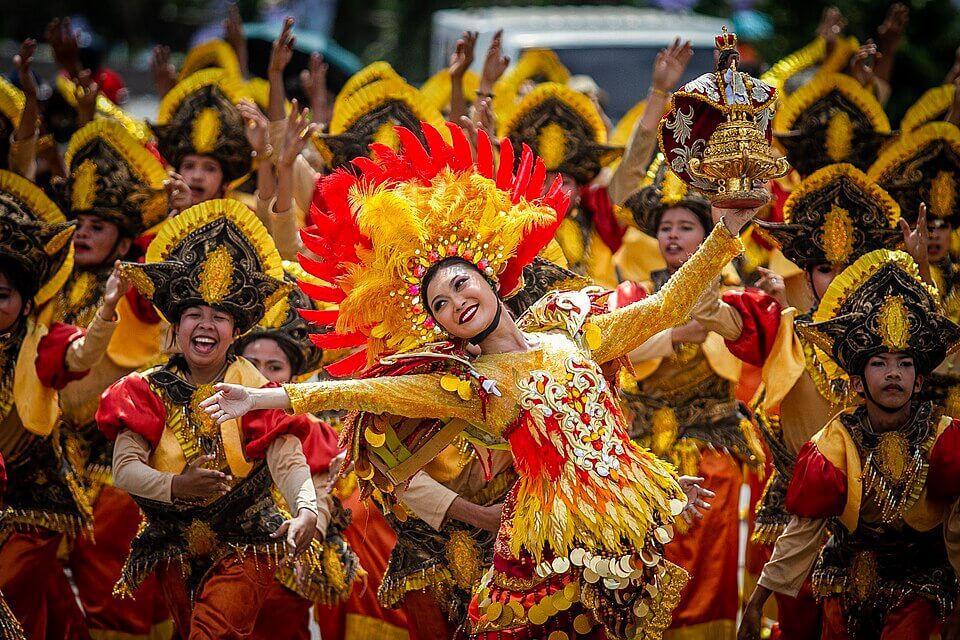
Religious festivals are among the most vibrant expressions of faith in the Philippines. These religious festivals in the Philippines reflect a unique blend of Catholic devotion, indigenous traditions, and community celebration. Over time, many of these events have evolved beyond purely religious observances into major cultural and tourism highlights, while still preserving their spiritual roots.
Sinulog Festival (Cebu)
The Sinulog Festival in Cebu is one of the country’s most famous religious celebrations, held annually in honor of the Santo Niño (Child Jesus). Its origins trace back to early Spanish colonization, when Christianity was first introduced to the island.
The festival is best known for its grand street dances, where performers move in a rhythmic forward-backward pattern, symbolizing the flow of the river. Participants wear vibrant costumes, accompanied by drumbeats and chants of devotion.
While deeply rooted in Catholic faith, Sinulog has grown into a major cultural event that attracts both local and international visitors. It showcases Cebu’s history, creativity, and community pride, blending religious reverence with large-scale celebration.
Ati-Atihan Festival (Aklan)
Often referred to as the “Mother of All Philippine Festivals,” the Ati-Atihan Festival in Aklan honors the Santo Niño while also reflecting pre-colonial influences. The festival commemorates a historic interaction between Malay settlers and the indigenous Ati people.
Participants paint their faces black and wear tribal-inspired costumes as they dance through the streets. The phrase “Hala Bira!” echoes throughout the celebration, creating an energetic and immersive atmosphere.
Ati-Atihan stands out for its strong connection to both indigenous heritage and Catholic devotion. It demonstrates how Filipino festivals have evolved—merging spiritual meaning with cultural identity and historical storytelling.
Pahiyas Festival (Quezon)
The Pahiyas Festival, celebrated in Lucban, Quezon, is a thanksgiving festival in honor of San Isidro Labrador, the patron saint of farmers. It reflects the deep relationship between faith, agriculture, and community life.
During the festival, homes are decorated with colorful displays of rice, fruits, vegetables, and kiping—leaf-shaped rice wafers dyed in vibrant colors. Streets become open galleries showcasing creativity and abundance.
While rooted in Catholic devotion, Pahiyas has evolved into a visual and cultural celebration that attracts tourists from across the country and beyond. It highlights local craftsmanship, agricultural pride, and the importance of gratitude in Filipino culture.
Faith, Culture, and Community
These festivals illustrate how religion in the Philippines extends beyond church walls. They serve as expressions of faith, identity, and unity—bringing communities together through shared traditions.
At the same time, their growing popularity as tourism events contributes to local economies and global recognition. Despite modernization, their spiritual foundations remain intact, making them powerful symbols of how faith and culture continue to coexist in Filipino society.
Iconic Catholic Churches and Heritage Sites
The legacy of Catholicism is visible across the country through its historic churches and religious landmarks. These churches in the Philippines are not only places of worship but also enduring symbols of history, architecture, and cultural identity. Many of them date back to the Spanish colonial period and reflect a unique blend of European design adapted to local conditions.
San Agustin Church
Located within the historic walled city of Intramuros, San Agustin Church is the oldest stone church in the Philippines, completed in 1607. It is a UNESCO World Heritage Site and part of the Baroque Churches of the Philippines.
Its architecture features thick stone walls, intricate carvings, and a beautifully painted ceiling that gives the illusion of three-dimensional detail. Designed to withstand earthquakes, it represents the “Earthquake Baroque” style unique to the Philippines.
Manila Cathedral
Also located in Intramuros, the Manila Cathedral serves as the seat of the Archdiocese of Manila. Originally established in 1571, the cathedral has been rebuilt several times due to natural disasters and war.
Today, it stands as a symbol of resilience and faith. Its grand Romanesque Revival architecture, stained glass windows, and historic significance make it one of the most important religious landmarks in the country.
Paoay Church
Paoay Church, officially known as Saint Augustine Church, is another UNESCO-listed site and one of the most iconic examples of Philippine Baroque architecture. Built in the late 17th century, it is famous for its massive buttresses that support the structure against earthquakes.
The church’s distinct design combines European Baroque elements with local materials and construction techniques, showcasing how Spanish colonial architecture was adapted to the Philippine environment.
Spanish Colonial Architecture and Cultural Legacy
These churches illustrate how Spanish colonial influence shaped the architectural landscape of the Philippines. Thick walls, coral stone materials, and fortress-like designs were developed to withstand both natural disasters and external threats.
Today, these heritage churches stand as living monuments—preserving centuries of history, faith, and craftsmanship. They continue to serve as places of worship while also attracting visitors interested in culture, architecture, and the enduring legacy of Catholicism in the Philippines.

Catholic Values and Social Influence
The enduring presence of faith in the country is reflected in the Catholic values in the Philippines, which continue to shape social behavior, relationships, and community life. These values are not confined to church teachings—they are lived daily through family interactions, social norms, and collective traditions.
Strong Family Orientation
One of the most visible influences of Catholic values is the central role of the family. Catholic teachings emphasize the importance of family as the foundation of society, and this is deeply reflected in Filipino life. Families often remain closely connected, with extended relatives playing active roles in decision-making, celebrations, and support systems.
Religious milestones such as baptisms, confirmations, weddings, and funerals further reinforce the importance of family unity and shared faith.
Charity and Compassion
Catholicism places strong emphasis on compassion, generosity, and service to others. These principles are widely practiced in Filipino communities, where helping those in need is seen as both a moral duty and a cultural expectation.
Acts of kindness—such as sharing food, supporting neighbors during difficult times, or participating in community outreach—reflect this value. Charity is often organized through churches, but it also exists informally within families and neighborhoods.
Respect for Elders
Respect for elders is another value reinforced by both Filipino culture and Catholic teachings. Elders are regarded as sources of wisdom and guidance, and their presence is honored in both family and community settings.
This respect is expressed through polite language, attentive listening, and traditional gestures such as the mano. It reflects a broader cultural emphasis on humility and social harmony.
Community Life and Collective Identity
Catholic values also contribute to a strong sense of community. Church activities, fiestas, and religious gatherings bring people together, creating opportunities for shared experiences and collective participation.
In many towns, the church serves as a central gathering place, reinforcing social connections and community identity. These shared traditions strengthen bonds among individuals and promote cooperation and unity.
These values demonstrate how Catholicism continues to influence Filipino society. By shaping attitudes toward family, compassion, respect, and community, Catholic values remain an essential part of everyday life in the Philippines.
Catholicism in Modern Filipino Society
Catholicism remains a powerful presence in the modern Catholic Philippines, continuing to influence daily life, social values, and national discourse. While the country has evolved through globalization and modernization, the role of the Church and religious traditions remains deeply embedded in Filipino society.
Continued Influence in Daily Life
For many Filipinos, faith is still part of everyday routines. Attending Sunday Mass, saying daily prayers, and observing religious holidays are common practices. Churches continue to serve as community centers where people gather not only for worship but also for social and charitable activities.
Religious traditions such as baptisms, weddings, and fiestas remain significant milestones, reinforcing the enduring connection between faith and family life.
Church and Politics
The Catholic Church has historically played an influential role in Philippine politics and social issues. It has been a vocal presence on matters such as social justice, human rights, and moral values.
One of the most notable examples was during the 1986 People Power Revolution, when church leaders and institutions supported peaceful demonstrations that led to political change. Today, the Church continues to influence public discussions, although its role is sometimes debated in an increasingly diverse and modern society.
Youth and Evolving Faith Practices
Among younger generations, Catholicism is evolving in both expression and engagement. While many still identify with the faith, participation may take on different forms. Some young Filipinos engage through youth ministries, community outreach programs, or digital platforms that share religious content.
Others may practice their faith more privately, reflecting broader global trends of individualized spirituality. Social media and modern lifestyles also influence how religious beliefs are expressed and discussed.
Despite these changes, Catholicism in the Philippines remains resilient. It continues to adapt while maintaining its core influence—bridging tradition and modernity in a society where faith still plays a meaningful role in shaping identity and community life.

Cultural Reflection – Faith as a Way of Life
In the Philippines, religion is not confined to church walls or specific moments of worship. It is woven into the rhythms of daily life, shaping what can best be described as a Filipino cultural identity rooted in faith. Catholicism, in this context, is not only a belief system—it is a lived experience that influences how people think, feel, and connect with one another.
Faith Beyond Ritual
While Mass, prayers, and religious observances remain important, faith in the Philippines extends far beyond formal rituals. It is present in everyday actions—expressions of gratitude, quiet prayers before meals, or moments of reflection during times of hardship. Faith becomes a guiding force, offering comfort, hope, and a sense of purpose in daily life.
Emotional and Communal Expression
Filipino spirituality is deeply emotional and communal. Religious events are not just observed—they are felt. Processions, festivals, and devotions often involve entire communities, creating shared experiences that strengthen social bonds. These expressions of faith are often marked by sincerity and intensity, reflecting a personal connection that goes beyond doctrine.
In these moments, faith becomes a collective experience—one that unites individuals through shared belief and cultural identity.
Balancing Tradition and Modernity
In a rapidly changing world, Filipino society continues to balance long-standing traditions with modern influences. While younger generations may express their faith in new ways—through digital platforms, personal reflection, or community service—the essence of Filipino spirituality remains intact.
This balance reflects adaptability rather than loss. Faith evolves alongside society, maintaining its relevance while preserving its cultural roots.
Ultimately, Catholicism in the Philippines is not simply practiced—it is lived. It shapes identity, strengthens community, and offers continuity in a world of change, making faith an enduring cornerstone of Filipino life.
Takeaway – A Living Faith and Cultural Legacy
Catholicism in the Philippines stands as more than a religious tradition—it is a living cultural legacy that continues to shape the nation’s identity. From its historical roots during the Spanish colonial period to its presence in modern Filipino life, Catholicism has influenced traditions, values, and community life across generations.
Its significance can be seen not only in churches and religious celebrations, but also in everyday practices—family gatherings, acts of compassion, and the strong sense of community that defines Filipino society. Faith has become deeply intertwined with culture, creating a unique expression of spirituality that reflects both history and local identity.
Despite the changes brought by modernization, Catholicism remains a unifying force that connects Filipinos across regions and even across the global diaspora. It continues to guide moral values, inspire resilience, and strengthen social bonds.
As both a historical foundation and a present-day influence, Catholicism remains an essential part of what it means to be Filipino.

Frequently Asked Questions
Why is the Philippines a Catholic country?
The Philippines is predominantly Catholic due to more than 300 years of Spanish colonial rule, beginning in the 16th century. Spanish missionaries actively spread Christianity across the islands, establishing churches, schools, and parish communities. Over time, Catholicism became deeply integrated into Filipino culture, blending with indigenous traditions and becoming the dominant religion in the country.
What are the main Catholic traditions in the Philippines?
Some of the most important Catholic traditions in the Philippines include Simbang Gabi (a series of dawn masses before Christmas), Holy Week observances, and fiesta celebrations honoring patron saints. These traditions are often community-centered, involving processions, church services, and gatherings that bring families and neighborhoods together.
What happens during Holy Week in the Philippines?
Holy Week, or Semana Santa, is one of the most significant religious periods in the Philippines. It commemorates the passion, death, and resurrection of Jesus Christ. Throughout the week, Filipinos participate in processions, attend church services, and observe moments of reflection.
Good Friday is particularly solemn, with many businesses closing and communities focusing on prayer and religious rituals. In some areas, reenactments and acts of devotion highlight the depth of faith among participants.
What is Simbang Gabi?
Simbang Gabi is a unique Filipino Catholic tradition consisting of nine consecutive dawn masses held from December 16 to 24. It is both a religious and cultural event, often attended by large numbers of devotees. Many Filipinos believe that completing all nine masses can lead to the fulfillment of personal prayers or wishes.
Are Filipinos very religious?
Yes, many Filipinos are considered highly religious. Faith plays an important role in daily life, influencing values, traditions, and social behavior. Religious practices such as attending Mass, celebrating religious festivals, and observing family traditions remain common across the country, reflecting the strong influence of Catholicism in Filipino society.



Catholicism in the Philippines is expressed not only through belief, but through vibrant traditions that bring communities together. These Filipino Catholic traditions are deeply woven into daily life, reflecting a faith that is both spiritual and cultural, personal and communal.