
Do Filipinos Celebrate the Chinese New Year? A Cultural and Historical Guide

A Shared Celebration in the Philippines

Yes, many Filipinos celebrate Chinese New Year. While the holiday is deeply rooted in Chinese tradition, it has become a widely recognized and observed celebration in the Philippines, particularly in communities with strong Filipino-Chinese heritage.
Chinese New Year is especially vibrant among Filipino-Chinese (Tsinoy) families, who honor ancestral customs, gather for reunions, and observe traditional rituals for prosperity and good fortune. However, the celebration extends beyond Chinese-Filipino households. Over time, many non-Chinese Filipinos have embraced selected traditions—such as preparing 12 round fruits, eating tikoy, wearing red, and welcoming the New Year with noise and fireworks.
This shared observance reflects centuries of historical ties between the Philippines and China. From pre-colonial trade to migration during the Spanish era, Chinese influence has long been part of Filipino society. Today, Chinese New Year in the Philippines represents more than an imported festival—it is a cultural blending shaped by history, identity, and modern life.
Understanding how Filipinos celebrate Chinese New Year requires looking at historical roots, cultural integration, and contemporary practices. It is a story of tradition preserved, adapted, and woven into the multicultural fabric of the Philippines.
Table of Contents
Why Chinese New Year Is Celebrated in the Philippines
Chinese New Year is celebrated in the Philippines because of centuries of historical connection, migration, and cultural integration between Filipinos and Chinese communities. The observance is not recent—it is rooted in deep and enduring ties.
Early Chinese Trade With Pre-Colonial Filipinos
Long before Spanish colonization, Chinese traders were already engaging in commerce with coastal Filipino communities. Archaeological evidence and historical records show active trade between Chinese merchants and early Filipinos, particularly in ceramics, silk, and food products. These early exchanges laid the foundation for cultural interaction that would continue for centuries.
Migration and Establishment of Chinese Communities
During the Spanish colonial period, waves of Chinese migrants settled in the Philippines, particularly in Manila and surrounding areas. Many established businesses and communities, with Binondo becoming one of the earliest and most significant Chinatowns in the world. Over time, Chinese customs, festivals, and family traditions—including Lunar New Year—became firmly rooted in Philippine society.
The Rise of the Tsinoy (Filipino-Chinese) Identity
As generations passed, intermarriage and cultural blending gave rise to the Tsinoy identity—a fusion of Chinese heritage and Filipino culture. Filipino-Chinese families maintained traditional practices such as honoring ancestors and celebrating Chinese New Year, while also fully participating in Filipino social and civic life.
Cultural Integration Into Mainstream Filipino Society
Today, Chinese New Year in the Philippines is not confined to Chinese-Filipino households. Many non-Chinese Filipinos participate in selected traditions, such as preparing round fruits for prosperity or attending lion dance performances. This widespread participation reflects how Chinese New Year has moved beyond ethnic boundaries to become part of the Philippines’ broader multicultural landscape.
Chinese New Year is therefore celebrated in the Philippines not as a foreign import, but as a tradition shaped by shared history, blended identities, and ongoing cultural exchange.

Is Chinese New Year a Holiday in the Philippines?
Chinese New Year is officially recognized in the Philippines as a special non-working holiday. This status reflects the country’s acknowledgment of its long-standing Chinese heritage and the significant role of the Filipino-Chinese community in national life.
Official Status as a Special Non-Working Holiday
Under Philippine law, Chinese New Year is declared a special non-working holiday, usually announced annually through a presidential proclamation. While employees are not automatically entitled to full holiday pay unless they work that day, many offices and businesses adjust operations in observance of the occasion.
Government Recognition and National Observance
The government’s recognition of Chinese New Year underscores the Philippines’ multicultural identity. Public greetings from national and local leaders, official ceremonies, and support for Chinatown celebrations—especially in Binondo, Manila—highlight its importance. The holiday is not limited to religious observance; it is treated as a cultural celebration embraced by many Filipinos.
Impact on Businesses, Schools, and Public Events
On Chinese New Year, some schools suspend classes, and certain businesses either close or operate on limited hours. Shopping malls, however, often host lion dances, cultural shows, and promotional events. Public celebrations in major cities attract both Filipino-Chinese families and non-Chinese Filipinos, making it one of the most visible cultural holidays in the country.
Where Chinese New Year Is Most Celebrated
Chinese New Year is observed across the Philippines, but some places stand out for their vibrant public celebrations and deep cultural roots.
Binondo, Manila – The Oldest Chinatown in the World
Binondo, located in Manila, is the heart of Chinese New Year celebrations in the Philippines. As the world’s oldest Chinatown, it becomes a center of festivity during the Lunar New Year.
Street festivals, dragon and lion dances, fireworks fill Ongpin Street and surrounding areas.
Traditional performances draw large crowds of both Filipino-Chinese families and non-Chinese Filipinos.
Cultural shows and temple visits are common, with many visiting local temples to offer prayers for prosperity, health, and good fortune.
The atmosphere in Binondo reflects centuries of Chinese-Filipino heritage and remains the most iconic place to experience the celebration.
Cebu, Davao, and Other Major Cities
Beyond Manila, Chinese New Year is widely celebrated in other urban centers.
Major cities such as Cebu and Davao host lion dances, public performances, and ceremonial events.
Shopping malls organize themed decorations, cultural showcases, and community programs.
Business districts and local governments often support organized festivities that highlight multicultural unity.
These celebrations make Chinese New Year visible even to Filipinos who are not part of the Chinese community.
Filipino-Chinese Households
While public festivals are prominent, the most meaningful celebrations often take place at home.
Families gather for reunion dinners, similar to Media Noche during Filipino New Year.
Traditional foods such as tikoy and noodles are prepared.
Some households perform ancestral rituals and prayers, honoring both heritage and family continuity.
In these homes, Chinese New Year is less about spectacle and more about gratitude, prosperity, and family unity.
How Filipinos Celebrate Chinese New Year
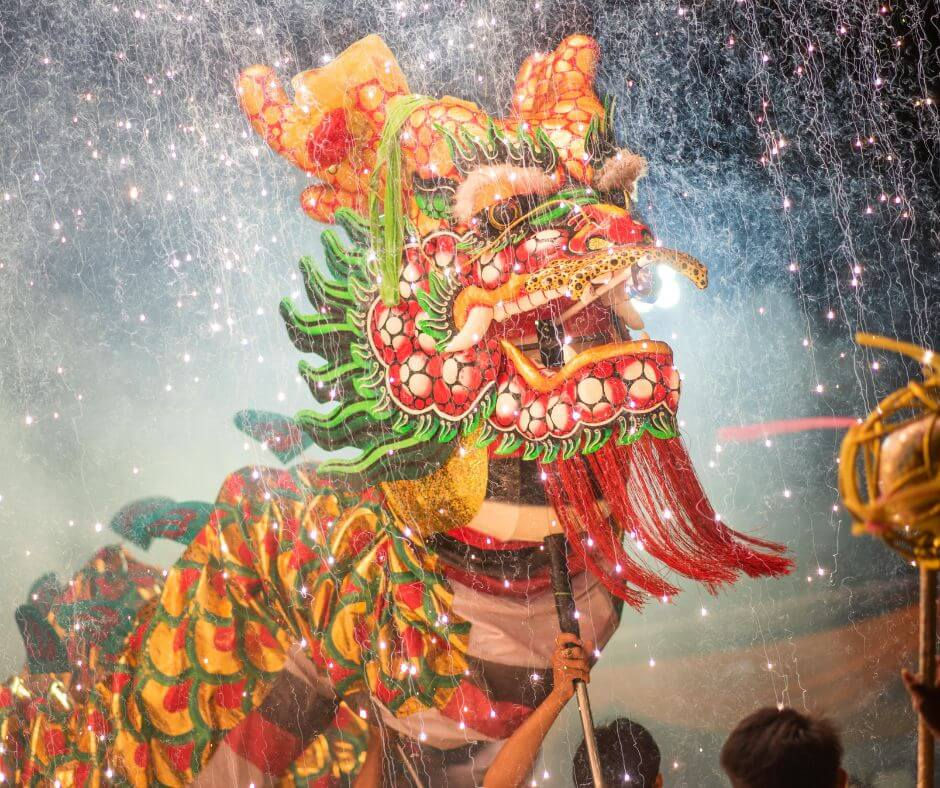
Chinese New Year in the Philippines combines traditional Chinese customs with local Filipino practices. While celebrations vary by community, several rituals are widely observed across the country.
1. Lion and Dragon Dances
One of the most recognizable traditions is the lion and dragon dance, performed in streets, malls, and business establishments.
The lion dance is believed to bring prosperity and ward off bad luck.
Performers visit shops and homes to symbolically “bless” them for the year ahead.
The rhythmic drums and cymbals add energy and excitement to the celebration.
These performances are especially prominent in Binondo and other major cities.
2. Giving Ang Pao (Red Envelopes)
The exchange of ang pao—red envelopes containing money—is a central custom.
Elders and married couples give ang pao to children and younger relatives.
The money represents blessings, prosperity, and good fortune for the coming year.
The red envelope itself symbolizes luck and protection.
In the Philippines, this tradition has also influenced gift-giving practices beyond the Filipino-Chinese community.
3. Eating Lucky Foods
Food plays a major symbolic role in welcoming prosperity.
12 round fruits are displayed to represent abundance and continuous wealth.
Tikoy (nian gao) symbolizes unity, sweetness, and stronger family bonds.
Long noodles represent longevity and a long life.
These food traditions are widely adopted, even by non-Chinese Filipino households.
4. Wearing Red and Bright Colors
Red is considered a powerful color during Chinese New Year.
Wearing red is believed to attract good luck and positive energy.
Bright clothing is encouraged to symbolize joy and optimism.
Many homes are decorated with red lanterns and gold accents.
This visual symbolism adds vibrancy to celebrations across the country.
5. Fireworks and Noise-Making
Noise is an essential part of the celebration.
Fireworks and firecrackers are believed to drive away bad spirits and negative energy.
Loud sounds, music, and cheering mark the beginning of a prosperous year.
In recent years, organized fireworks displays have replaced personal firecrackers in some areas for safety.
Chinese New Year vs. Filipino New Year Traditions
Chinese New Year and Filipino New Year (celebrated on January 1) share several similarities in rituals and superstitions. However, they differ in historical origins, symbolism, and cultural emphasis. Over time, these traditions have influenced each other, creating a uniquely blended celebration in the Philippines.
Similar Superstitions and Prosperity Rituals
Many Filipinos observe customs that appear in both celebrations:
Round fruits symbolize wealth and continuous prosperity.
Loud noise and fireworks are believed to drive away bad spirits and negative energy.
Food rituals emphasize abundance, longevity, and unity.
Wearing bright or lucky colors reflects hope and optimism for the coming year.
These shared practices highlight a common focus on renewal, prosperity, and protection.
Differences in Cultural Origin and Symbolism
Despite similarities, the two celebrations have distinct roots:
Chinese New Year follows the lunar calendar and is rooted in Chinese traditions, ancestral rituals, and zodiac symbolism.
Filipino New Year aligns with the Gregorian calendar and is influenced by Spanish colonial heritage and Western traditions.
Chinese New Year centers on family reunions within the Filipino-Chinese community, while January 1 celebrations are more universally observed across Filipino households.
The symbolism in Chinese New Year often emphasizes zodiac cycles and ancestral reverence, whereas Filipino New Year traditions focus on luck, prosperity, and festive family gatherings.
How Traditions Overlap and Influence Each Other
Over centuries of coexistence, traditions have blended naturally. Practices such as preparing 12 round fruits or setting off fireworks during January 1 celebrations reflect Chinese cultural influence. At the same time, Filipino hospitality and communal feasting shape how Lunar New Year is celebrated locally.
This cultural exchange illustrates how the Philippines embraces diversity. Rather than competing, Chinese and Filipino New Year traditions coexist—each enriching the other while maintaining their unique historical identities.

The Role of the Filipino-Chinese (Tsinoy) Community
The celebration of Chinese New Year in the Philippines is closely tied to the enduring presence and influence of the Filipino-Chinese, or Tsinoy, community. For generations, Tsinoys have played a vital role in shaping the country’s economic, cultural, and social landscape.
Business and Economic Contributions
The Filipino-Chinese community has long been active in commerce and entrepreneurship. From small family-owned shops to large corporations, Tsinoy businesses have contributed significantly to trade, retail, manufacturing, and finance across the country. Their economic participation has strengthened local communities and helped drive national development, making Chinese New Year not only a cultural event but also a celebration of a community deeply embedded in Philippine society.
Cultural Preservation Through Schools and Temples
Tsinoy families have maintained cultural traditions through Chinese schools, cultural organizations, and temples. These institutions teach language, history, values, and traditional practices to younger generations. During Chinese New Year, temples host prayers and ceremonies, while schools organize cultural programs that reinforce heritage and identity. This preservation ensures that traditions are passed down while remaining relevant in a modern Filipino context.
Blending Chinese Heritage With Filipino Identity
Perhaps the most distinctive aspect of the Tsinoy community is its blended identity. Filipino-Chinese families often celebrate both Chinese New Year and major Filipino holidays such as Christmas and Independence Day. Many speak Filipino and local dialects alongside Chinese languages. This integration reflects a shared identity—deeply Filipino, yet proudly connected to Chinese roots.
Through economic participation, cultural preservation, and social integration, the Tsinoy community plays a central role in keeping Chinese New Year meaningful in the Philippines. Their presence illustrates how cultural heritage can be preserved while fully belonging to a broader national identity.
Do Non-Chinese Filipinos Celebrate?
While Chinese New Year is rooted in Chinese tradition, many non-Chinese Filipinos also participate in the celebration—often in cultural rather than religious ways.
Adoption of Selected Traditions
Over time, several Lunar New Year customs have been embraced by Filipino households beyond the Filipino-Chinese community. Practices such as displaying 12 round fruits for prosperity, wearing red for good luck, preparing tikoy, and welcoming the year with fireworks have become familiar rituals for many families. These traditions are often observed as symbols of hope and abundance rather than strict cultural obligations.
Participation in Public Events
Non-Chinese Filipinos actively attend public celebrations, especially in places like Binondo and major shopping malls. Lion and dragon dances, cultural performances, and festive decorations attract families from diverse backgrounds. For many, attending these events is a way to experience the country’s multicultural heritage and join in the communal spirit of renewal.
Cultural Rather Than Religious Observance
For most non-Chinese Filipinos, Chinese New Year is not a religious event but a cultural celebration. It represents prosperity, positivity, and fresh beginnings—values that resonate broadly across Filipino society. Participation is often about shared festivity and appreciation rather than adherence to traditional rituals.
In this way, Chinese New Year in the Philippines extends beyond ethnic boundaries. It has become a celebration that reflects cultural blending, openness, and the country’s long history of cross-cultural exchange.

Modern Celebrations and Social Media Influence
Chinese New Year in the Philippines has evolved alongside modernization, commerce, and digital culture. While traditional rituals remain important, contemporary celebrations are increasingly shaped by media, marketing, and online engagement.
Mall Promotions and Commercial Events
Shopping malls across major cities decorate their spaces with red lanterns, zodiac displays, and festive installations. Lion and dragon dances are scheduled as public performances, often attracting large crowds. Retail promotions, themed sales, and brand collaborations have made Chinese New Year a significant commercial period, blending cultural observance with consumer activity.
Digital Greetings and Online Campaigns
Social media platforms play a major role in how Filipinos celebrate today. Families exchange digital greetings, businesses launch Lunar New Year campaigns, and influencers create themed content highlighting traditions, food, and fashion. Online posts featuring lucky colors, zodiac signs, and prosperity rituals amplify awareness beyond physical gatherings.
Influence of Tourism and Media Coverage
Tourism boards and local governments promote Chinese New Year celebrations to attract visitors, particularly in Binondo and other cultural districts. Media coverage showcases street festivals, temple ceremonies, and public events, reinforcing the holiday’s visibility nationwide. This exposure not only strengthens cultural appreciation but also positions the Philippines as a multicultural destination.
Misconceptions About Chinese New Year in the Philippines
Despite its widespread visibility, several misconceptions surround Chinese New Year in the Philippines. Clarifying these helps better understand its true cultural role in Filipino society.
“It Is Only for Chinese Families”
While Chinese New Year is rooted in Chinese heritage, it is not exclusively celebrated by Chinese-Filipino families. Many non-Chinese Filipinos participate by attending public festivals, preparing lucky foods, or observing selected traditions. The holiday has become part of the Philippines’ multicultural landscape, embraced beyond ethnic boundaries.
“It Is a Religious Holiday”
Chinese New Year is primarily a cultural and traditional celebration rather than a strictly religious one. Although some families perform temple rituals or ancestral offerings, many observances focus on prosperity, renewal, and family reunion. In the Philippines, participation is often cultural—centered on food, symbols, and shared festivities rather than religious doctrine.
“It Replaces Filipino New Year Traditions”
Chinese New Year does not replace the January 1 Filipino New Year celebration. Both are observed separately and have different historical origins. Filipino New Year follows the Gregorian calendar and reflects Spanish and Western influences, while Chinese New Year follows the lunar calendar and Chinese traditions. Instead of competing, the two celebrations coexist and sometimes influence each other.
Understanding these distinctions shows that Chinese New Year in the Philippines is a reflection of cultural blending—expanding tradition without diminishing existing Filipino customs.

Why Chinese New Year Matters in Filipino Culture Today
Chinese New Year holds meaningful significance in contemporary Filipino society because it reflects the country’s layered history, cultural openness, and evolving identity.
Symbol of Multicultural Identity
The Philippines is shaped by Indigenous roots, Asian trade networks, and centuries of colonial influence. Chinese New Year stands as a visible reminder of this multicultural identity. Its nationwide recognition as a special non-working holiday affirms that Filipino identity is not singular but diverse. Celebrating Lunar New Year alongside Christmas and other national holidays highlights the country’s inclusive cultural character.
Reflection of Centuries-Old Trade and Migration Ties
Long before colonial rule, Chinese traders interacted with early Filipino communities. Over time, migration, intermarriage, and economic partnerships deepened these ties. Today’s Filipino-Chinese community represents generations of shared history. Chinese New Year honors this enduring relationship and acknowledges the role of Chinese heritage in shaping Philippine commerce, cuisine, language, and social life.
Example of Cultural Blending in the Philippines
Chinese New Year in the Philippines is not simply replicated from mainland traditions—it has adapted locally. Filipino practices such as communal feasting, hospitality, and neighborhood celebrations blend naturally with Lunar New Year rituals. This fusion illustrates how cultures evolve through exchange rather than isolation.
In modern Filipino culture, Chinese New Year is more than a festival. It represents coexistence, adaptation, and the ability of different traditions to thrive together within a shared national identity.
Takeaway – A Celebration of Cultural Harmony
Yes, Filipinos do celebrate Chinese New Year. While it is deeply rooted in Chinese tradition, it has become a meaningful and visible part of life in the Philippines. From vibrant street festivals in Binondo to family reunions in Filipino-Chinese households—and even selected customs embraced by non-Chinese Filipinos—the celebration reflects shared history and cultural exchange.
Chinese New Year in the Philippines highlights themes of unity, prosperity, renewal, and family. It brings communities together through food, symbolism, and public celebration, reinforcing values that resonate across cultures. Rather than replacing existing traditions, it complements them, enriching the broader Filipino calendar of festivities.
Ultimately, Chinese New Year stands as a reminder that the Philippines is a multicultural society shaped by centuries of interaction and adaptation. Its observance demonstrates how different cultural traditions can coexist, blend, and thrive—creating a national identity that is diverse, inclusive, and deeply interconnected.

Frequently Asked Questions
Do Filipinos celebrate Chinese New Year?
Yes, many Filipinos celebrate Chinese New Year. It is widely observed, especially among Filipino-Chinese (Tsinoy) communities, and many non-Chinese Filipinos also participate in selected traditions such as preparing lucky foods and attending public festivities.
Is Chinese New Year a holiday in the Philippines?
Yes. Chinese New Year is officially declared a special non-working holiday in the Philippines. This recognition reflects the country’s multicultural heritage and the significant contributions of the Filipino-Chinese community.
Why do Filipinos eat tikoy?
Tikoy, also known as nian gao, symbolizes unity, sweetness, and stronger family bonds. In the Philippines, it has become one of the most popular Chinese New Year foods, often given as gifts and shared during family gatherings.
What is Binondo known for during Chinese New Year?
Binondo in Manila, known as the world’s oldest Chinatown, is famous for its large-scale celebrations during Chinese New Year. It hosts lion and dragon dances, street festivals, temple visits, fireworks, and cultural performances that attract both locals and tourists.
How is Chinese New Year different from Filipino New Year?
Chinese New Year follows the lunar calendar and is rooted in Chinese traditions, ancestral rituals, and zodiac symbolism. Filipino New Year, celebrated on January 1, follows the Gregorian calendar and is influenced by Spanish and Western customs. While they share similar prosperity rituals, they have different historical origins and cultural meanings.



Chinese New Year is especially vibrant among Filipino-Chinese (Tsinoy) families, who honor ancestral customs, gather for reunions, and observe traditional rituals for prosperity and good fortune. However, the celebration extends beyond Chinese-Filipino households. Over time, many non-Chinese Filipinos have embraced selected traditions—such as preparing 12 round fruits, eating tikoy, wearing red, and welcoming the New Year with noise and fireworks.
Chinese New Year in the Philippines has evolved from a specific ethnic tradition into a shared national experience. It’s no longer just for the Tsinoy community; many non-Chinese Filipinos have adopted customs like wearing red, eating tikoy, and displaying round fruits. This blending shows how deeply Chinese heritage is woven into the multicultural fabric of Filipino identity...
Chinese New Year in the Philippines combines traditional Chinese customs with local Filipino practices. While celebrations vary by community, several rituals are widely observed across the country.