
The Philippine Flying Lemur – Meet the Mysterious Kagwang

Meet the Night Glider of the Philippine Forest

Hidden among the tropical forests of the southern Philippines lives one of the country's most unusual mammals—the Philippine Flying Lemur (Cynocephalus volans). Also known as the Philippine colugo or locally as the kagwang, this remarkable animal spends much of its life high in the trees, emerging after dark to search for food.
Despite its name, the Philippine Flying Lemur is not a true lemur, and it cannot actually fly. Instead, it is a highly specialized gliding mammal. A broad membrane of skin stretches between its limbs, neck, and tail, allowing it to launch from trees and glide impressive distances through the forest canopy.
Native to parts of the southern Philippines, including Mindanao, Bohol, Samar, and Leyte, the kagwang is perfectly adapted to life above the forest floor. Its large eyes help it navigate at night, while its mottled fur provides camouflage against tree trunks.
With its unusual appearance, nocturnal lifestyle, and extraordinary gliding ability, the Philippine Flying Lemur offers a fascinating glimpse into the remarkable biodiversity hidden within the forests of the Philippines.
Table of Contents - The Philippine Flying Lemur
What Is the Philippine Flying Lemur?
The Philippine Flying Lemur (Cynocephalus volans) is a tree-dwelling mammal native to the southern Philippines. It belongs to the order Dermoptera and the family Cynocephalidae, whose members are commonly known as colugos.
Why Is It Called a Flying Lemur?
The name can be misleading. The Philippine Flying Lemur does not truly fly like a bat or bird. Instead, it glides between trees using a large membrane of skin called the patagium, which stretches around much of its body.
It is also not a true lemur. Lemurs belong to the order Primates and are naturally associated with Madagascar, while the Philippine Flying Lemur belongs to the separate order Dermoptera.
Meet the Kagwang
In the Philippines, the animal is commonly known as the kagwang. It's unusual appearance and ability to glide through the forest canopy make it one of the country's most distinctive mammals.
A Close Relative of Primates
Colugos are especially fascinating because evolutionary research places Dermoptera among the closest living relatives of primates, the group that includes monkeys, apes, lemurs, and humans. Scientists therefore study colugos not only for their remarkable gliding adaptations but also for clues about mammalian evolution.
The Philippine Flying Lemur is a perfect example of how unusual and diverse Philippine wildlife can be.

Physical Characteristics and Gliding Adaptations
The Philippine Flying Lemur has one of the most unusual body designs of any mammal in the Philippines. Almost every feature helps it survive high in the forest canopy, from its camouflage and climbing claws to the remarkable membrane that allows it to glide between trees.
Built for Life in the Trees
Size and Weight: The Philippine Flying Lemur has a body roughly 35–43 centimeters long, with adults generally weighing around 1–1.7 kilograms.
Mottled Fur: Its grayish-brown or reddish-brown fur is covered with irregular markings that resemble bark, helping the animal remain hidden while resting against trees.
Large Eyes: Prominent forward-facing eyes help it see and navigate through the forest during its mostly nocturnal activities.
Claws and Feet: Strong, curved claws provide a secure grip when climbing and resting on trunks and branches.
Comb-Like Teeth: Its unusual lower incisors resemble tiny combs. These specialized teeth are thought to help with grooming and feeding.
Patagium: Its most remarkable adaptation is the patagium, a broad membrane of skin extending between the neck, limbs, fingers, toes, and tail. It creates an exceptionally large gliding surface.
A Natural Forest Glider
To begin a glide, the kagwang pushes away from a tree and spreads its limbs, stretching the patagium like a living parachute. By adjusting its body and membrane, it can steer toward another tree before raising its body and limbs to control the landing.
Philippine Flying Lemurs can reportedly glide more than 100 meters under favorable conditions, allowing them to travel through the canopy while minimizing time on the forest floor.
Where Does the Philippine Flying Lemur Live?
The Philippine Flying Lemur habitat is concentrated in the southern Philippines, where warm tropical environments provide the trees, vegetation, and food this highly arboreal mammal needs. Because the kagwang spends most of its life above the ground, healthy tree cover is especially important to its survival.
Where Is the Kagwang Found?
The Philippine Flying Lemur occurs on several islands, including:
Mindanao: Home to extensive forest habitats where the species can move through the canopy in search of food.
Bohol: One of the best-known islands associated with the kagwang and an important destination for travelers interested in Philippine wildlife.
Samar and Leyte: Forested areas on these islands provide additional habitat within the species' natural range.
Dinagat and Other Islands: Populations also occur on Dinagat and several smaller islands in the southern Philippine archipelago.
Life in the Forest Canopy
Kagwangs are most closely associated with tropical forests, but they can also live in secondary forests and some wooded agricultural landscapes, including tree and coconut plantations. During the day, they often rest against trunks or among branches before becoming active after dark.
Connected forests are particularly valuable because Philippine Flying Lemurs travel primarily through trees. Continuous canopy allows them to glide between feeding and resting areas without frequently descending to the ground.
Protecting and reconnecting forest habitats therefore benefits the kagwang while also providing shelter for countless other plants and animals that depend on the Philippines' tropical forests.

Diet, Behavior, and Nocturnal Lifestyle
The Philippine Flying Lemur spends nearly its entire life among the trees. Mostly active after sunset, the kagwang combines a plant-based diet, strong climbing abilities, and remarkable gliding skills to survive in the tropical forests of the southern Philippines.
What Does the Philippine Flying Lemur Eat?
The kagwang is primarily herbivorous, feeding on plant material available throughout the forest canopy. Its diet includes:
Young Leaves: Tender leaves are an important part of its diet and are easier to digest than mature foliage.
Flowers: Flowering trees provide seasonal food as the animal moves between branches.
Fruits: Various fruits supplement its diet with natural sugars and nutrients.
Shoots and Sap: Fresh shoots and other plant material provide additional food sources.
Rather than searching for food on the forest floor, the Philippine Flying Lemur feeds almost entirely among the trees.
Life After Dark
The kagwang is primarily nocturnal. During daylight hours, it usually rests against tree trunks or hides among branches. Its mottled gray and brown fur blends remarkably well with bark, providing natural camouflage from potential predators.
As darkness falls, the animal becomes active. Strong claws allow it to grip trunks and climb through vegetation while searching for suitable feeding trees.
When food is located across a gap in the canopy, the kagwang can launch from a branch and glide from tree to tree rather than climbing down to the ground. This energy-efficient movement helps it travel through its forest habitat while reducing exposure to dangers below.
Its combination of camouflage, nighttime activity, climbing, and gliding makes the Philippine Flying Lemur exceptionally well adapted to a life spent almost entirely above the forest floor.
Reproduction – How Mothers Raise Their Young
One of the most remarkable sights in the Philippine forest is a mother kagwang carrying her young high among the trees. Young Lemurs are born relatively undeveloped, making the bond between mother and baby especially important during the early stages of life.
From Birth to Independence
Breeding: Female Philippine Flying Lemurs typically give birth to a single young at a time.
Pregnancy and Birth: After a relatively short pregnancy of roughly two months, the baby is born small and highly dependent on its mother.
Clinging to Mother: Soon after birth, the young kagwang clings tightly to its mother's underside as she climbs, feeds, and moves through the forest canopy.
A Protective Gliding Membrane: The mother's patagium, or gliding membrane, can form a pouch-like fold around the baby, providing additional support and protection.
Growing Stronger: As the youngster develops, it gradually begins exploring nearby branches while remaining close to its mother.
Learning to Climb: Stronger limbs and claws eventually allow the young kagwang to move more confidently among trunks and branches.
Learning to Glide: With development and experience, it begins mastering the ability that defines its species—launching from trees, spreading its membrane, and gliding through the canopy.
From its earliest days, the life of a Philippine Flying Lemur is shaped by the forest—and by a mother that carries, protects, and prepares her young for life high among the trees.

Why the Philippine Flying Lemur Matters
The Philippine Flying Lemur is more than an unusual nighttime glider. As a species native to the Philippines, the kagwang represents the remarkable biodiversity that has developed across the country's islands and forests over millions of years.
Why Is the Kagwang Important?
Philippine Biodiversity: The kagwang adds to the extraordinary variety of mammals found in the Philippines and highlights the ecological importance of the country's remaining tropical forests.
Unique Evolutionary History: Philippine Flying Lemurs belong to Dermoptera, a small and highly distinctive order of mammals. Colugos are also among the closest living relatives of primates, making their evolutionary history especially fascinating.
Part of the Forest Ecosystem: As a plant-eating mammal, the kagwang is part of the complex relationships connecting vegetation, herbivores, predators, and other wildlife within tropical forest ecosystems.
Scientific Importance: Researchers study colugos to better understand gliding adaptations, mammalian evolution, anatomy, behavior, and the evolutionary relationships between different groups of mammals.
Philippine Natural Heritage: Known locally as the kagwang, this extraordinary animal is part of the country's unique natural heritage and another example of wildlife found nowhere else in quite the same way.
Protecting More Than One Species
Protecting the Philippine Flying Lemur also means protecting the forests it depends on. Conserving connected forest habitats provides shelter, food, and breeding areas not only for kagwangs but also for birds, reptiles, insects, plants, and other native mammals.
The kagwang reminds us that conserving one remarkable species can help preserve an entire community of Philippine wildlife.
Threats and Conservation
Although the Philippine Flying Lemur is currently classified as Least Concern, protecting its forest habitat remains important. The kagwang depends heavily on trees for feeding, resting, climbing, raising its young, and gliding, making changes to forest landscapes a continuing concern for the species.
Main Threats to the Kagwang
Deforestation: Clearing forests removes the trees the kagwang depends on for nearly every part of its life.
Habitat Fragmentation: When continuous forests are divided into isolated patches, moving safely between feeding and resting areas can become more difficult.
Agricultural Expansion: Converting natural forests into farms and plantations can reduce or alter suitable habitat.
Hunting: Kagwangs may face hunting pressure in some areas, adding another challenge to local populations.
Human Disturbance: Increasing activity near forest habitats can disturb wildlife and change natural behavior.
Infrastructure Development: Roads, settlements, and other construction can contribute to forest loss and fragmentation.
Philippine Flying Lemur Conservation
Protecting the kagwang requires protecting the landscapes where it lives. Important Philippine Flying Lemur conservation measures include:
Protecting remaining natural forests and protected areas
Restoring degraded forests through reforestation
Maintaining habitat connectivity between forest patches
Supporting scientific monitoring and wildlife research
Involving local communities in forest conservation
Expanding environmental education about native wildlife
The future of the kagwang is closely connected to the future of Philippine forests. Protecting those forests helps safeguard not just one remarkable gliding mammal, but entire ecosystems filled with native wildlife.
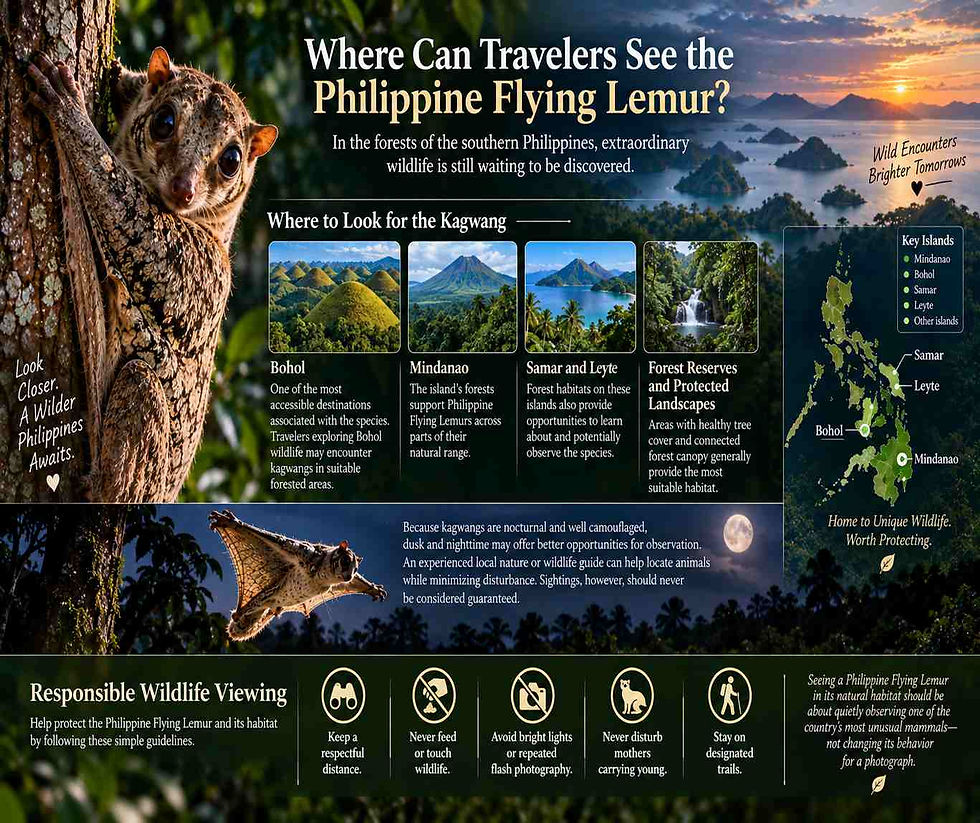
Where Can Travelers See the Philippine Flying Lemur?
For wildlife enthusiasts wondering where to see the Philippine Flying Lemur, the best opportunities are within its natural range in the southern Philippines. Because the kagwang is nocturnal, well camouflaged, and spends much of its life high in the trees, finding one in the wild can require patience.
Where to Look for the Kagwang
Bohol: One of the most accessible destinations associated with the species. Travelers exploring Bohol wildlife may encounter kagwangs in suitable forested areas.
Mindanao: The island's forests support Philippine Flying Lemurs across parts of their natural range.
Samar and Leyte: Forest habitats on these islands also provide opportunities to learn about and potentially observe the species.
Forest Reserves and Protected Landscapes: Areas with healthy tree cover and connected forest canopy generally provide the most suitable habitat.
Because kagwangs become more active after sunset, dusk and nighttime may offer better opportunities for observation. An experienced local nature or wildlife guide can help locate animals while minimizing disturbance. Sightings, however, should never be considered guaranteed.
Responsible Wildlife Viewing
If you are fortunate enough to encounter a kagwang:
Keep a respectful distance.
Never feed or touch wildlife.
Avoid bright lights or repeated flash photography.
Never disturb mothers carrying young.
Stay on designated trails.
Seeing a Philippine Flying Lemur in its natural habitat should be about quietly observing one of the country's most unusual mammals—not changing its behavior for a photograph.
Takeaway – The Night Glider of the Philippine Forest
The Philippine Flying Lemur is one of the Philippines' most unusual mammals. With its enormous gliding membrane, mottled camouflage, powerful claws, and ability to move between trees after dark, the kagwang is remarkably adapted to life in the forest canopy.
Its nocturnal lifestyle means many people may never see one, yet this quiet glider remains an important part of the country's extraordinary biodiversity. Protecting the kagwang also means protecting the forests that provide food and shelter for countless other native species.
The Philippine Flying Lemur reminds us that some of the country's most extraordinary wildlife is hidden high above the forest floor, quietly waiting for nightfall before taking to the trees.
Discover more Philippine wildlife, biodiversity, natural wonders, and conservation stories with KGM Resorts—and explore the remarkable species that make the Philippines one of the world's most fascinating natural destinations.
Frequently Asked Questions
What is a Philippine Flying Lemur?
The Philippine Flying Lemur (Cynocephalus volans) is a nocturnal, tree-dwelling mammal native to the southern Philippines. It is also known as the Philippine colugo or kagwang.
Is the Philippine Flying Lemur actually a lemur?
No. Despite its name, it is not a lemur or even a primate. It belongs to a separate order of mammals called Dermoptera. Colugos are, however, close evolutionary relatives of primates.
Can the Philippine Flying Lemur really fly?
No. It glides rather than flies. A large membrane of skin called the patagium stretches around much of its body, creating a broad surface for gliding between trees.
What does kagwang mean?
Kagwang is a local Philippine name commonly used for the Philippine Flying Lemur or colugo.
Where does the Philippine Flying Lemur live?
It occurs on several islands in the southern Philippines, including Mindanao, Bohol, Samar, Leyte, and Dinagat, as well as other islands within its natural range.
Is the Philippine Flying Lemur endangered?
The species is currently classified as Least Concern, although deforestation, habitat fragmentation, hunting, and other human pressures can threaten local populations.
Can you see Philippine Flying Lemurs in Bohol?
Yes, Bohol lies within the species' natural range. However, kagwangs are nocturnal and well camouflaged, so sightings are never guaranteed. Visiting suitable forest habitat with an experienced local guide can improve the chances of observing one responsibly.

Wild Philippines: An Adult Coloring Book
Discover the rare and extraordinary endemic animals of the Philippines through this beautifully detailed adult coloring book inspired by the country’s unique biodiversity. From the majestic Philippine Eagle and the tiny Philippine Tarsier to rare forest mammals, vibrant birds, and fascinating marine species found nowhere else on Earth, every page celebrates the remarkable wildlife of the Philippine archipelago. Featuring intricate tribal-inspired patterns, tropical elements, and nature-themed designs, this coloring book invites you to explore, unwind, and connect with the wild beauty of the Philippines.



That's Not My Neighbor creates a different kind of replay value by making every inspection feel slightly uncertain. Checking faces, documents, and small inconsistencies turns a simple doorman shift into a careful test of attention. Even after learning the basic routine, players can still encounter details that make them stop and question their first impression. That mix of observation, pressure, and unexpected discoveries gives each session its own rhythm.