
The Philippine National Museum of Fine Arts – A Journey Through Philippine Art

A Nation Told Through Art
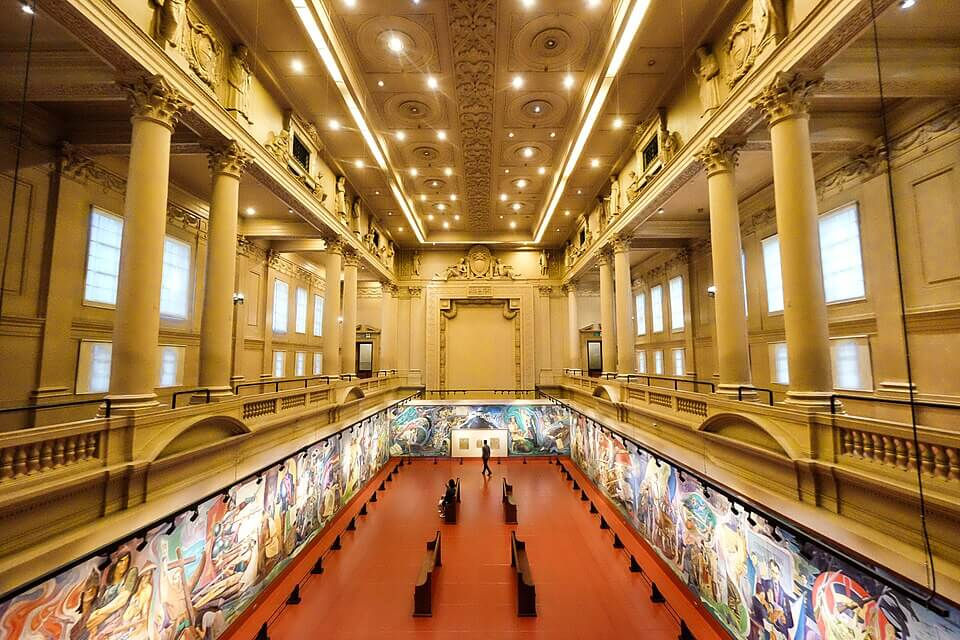
Walk into the National Museum of Fine Arts in Manila, and one of the first sights to command your attention is enormous: Juan Luna’s Spoliarium. But this masterpiece is only the beginning. Beyond it, gallery after gallery reveals something much larger—the story of a nation told through the eyes of its artists.
Housed in the historic Old Legislative Building near Rizal Park, the museum holds one of the Philippines’ most important collections of visual art. Here, works by Juan Luna, Félix Resurrección Hidalgo, Fernando Amorsolo, and generations of Filipino artists reveal how the country changed—and how Filipinos saw themselves within those changes.
These galleries carry echoes of colonialism, nationalism, war, independence, everyday life, and the continuing search for Filipino identity. Paintings and sculptures become more than objects to admire; they become windows into different moments in the nation’s story.
The National Museum of Fine Arts is therefore more than a museum.
It is a journey through the Philippines—painted, sculpted, remembered, and reimagined by Filipinos themselves.
Table of Contents - Philippine National Museum of Fine Arts
From Legislative Building to National Museum
The building that houses the National Museum of Fine Arts has witnessed nearly a century of Philippine history. Long before masterpieces filled its galleries, its halls were shaped by politics, war, reconstruction, and the country's changing national identity.
1. A Monumental Building Takes Shape
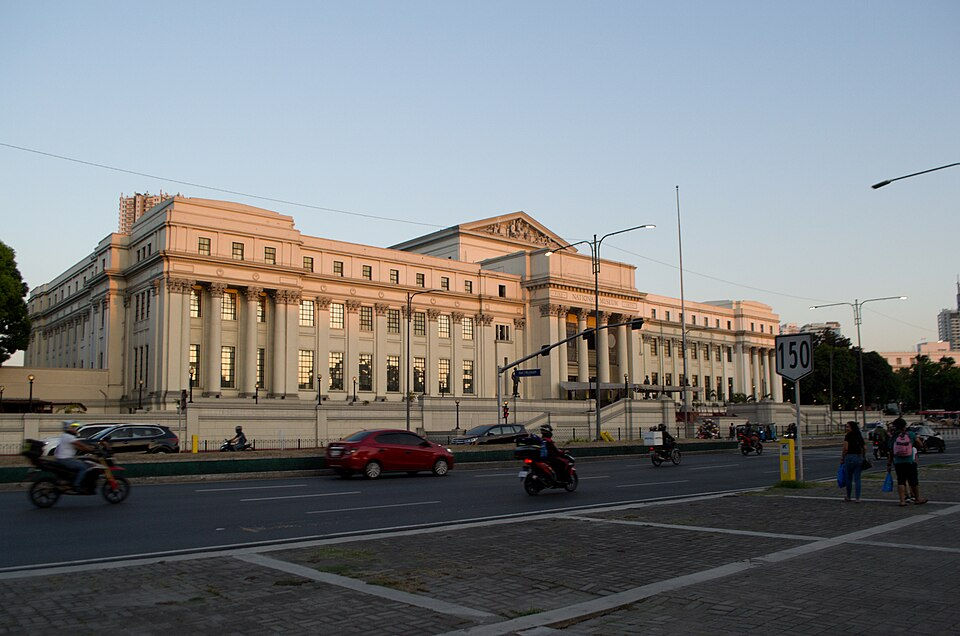
Construction began in 1918, when the site was originally intended for a National Library. As plans evolved, however, the building was redesigned to become the home of the Philippine Legislature. Filipino architect Juan M. Arellano played an important role in revising the design, helping create the imposing Neoclassical landmark completed in 1926.
Its early history can be traced through several important milestones:
1918 – Construction began under plans for a National Library.
Early 1920s – The project was redirected toward housing the Philippine Legislature.
1926 – The monumental Legislative Building was completed.
1945 – The structure was severely damaged during the Battle of Manila.
Postwar years – The building was reconstructed as the capital recovered from World War II.
2. The Home of the Philippine Legislature
For decades, the building stood at the center of Philippine political life. Legislators debated national issues within its chambers as the country moved through the American colonial period, greater self-government, and eventually independence. Its halls became witnesses to important chapters in the formation of the modern Philippine state.
3. Destruction and Reconstruction
During the Battle of Manila in 1945, the building became part of the devastated government district. Heavy fighting and bombardment severely damaged the structure. Like much of Manila, it had to rise again from the destruction of World War II.
4. From Political Power to Cultural Memory
Its purpose would eventually change dramatically. A building created for government became a home for Philippine art and cultural memory.
Today, visitors walk through spaces once associated with political power to encounter the works of Filipino masters. In that transformation lies something fitting: a building that once helped shape the country's laws now helps preserve the stories, creativity, and identity of its people.

Architecture – A Masterpiece Before You See the Art
Before visitors encounter the paintings and sculptures of the National Museum of Fine Arts, they are already standing inside a work of art. The former Legislative Building was designed to project dignity, permanence, and civic importance—qualities expressed through its imposing Neoclassical architecture.
1. A Monumental Neoclassical Façade
From the outside, the building commands attention with its balanced proportions, strong symmetry, and monumental scale. Rows of towering Corinthian columns reinforce the sense of grandeur, reflecting an architectural style widely used for important civic buildings during the early 20th century.
2. Grand Spaces Designed to Impress
Inside, broad staircases, high ceilings, long corridors, and formal galleries continue the building's monumental character. Natural light and spacious interiors give many of the artworks room to breathe, while the architecture reminds visitors that these spaces once served an entirely different purpose.
3. The Old Senate Session Hall
Among the building's most historically significant spaces is the Old Senate Session Hall, once a center of Philippine political life. Carefully restored, the hall preserves its imposing architectural character while allowing visitors to imagine the debates, decisions, and personalities that once filled the chamber.
4. Two Forms of Heritage Under One Roof
This combination makes the museum experience unusual. Visitors are not simply viewing Philippine heritage displayed on walls—they are walking through it.
The paintings and sculptures preserve the country's artistic memory, while the building preserves another layer of its political and architectural history. Together, they transform the National Museum of Fine Arts into a place where art, architecture, and history become part of the same Philippine story.
Spoliarium – The Painting That Greets a Nation
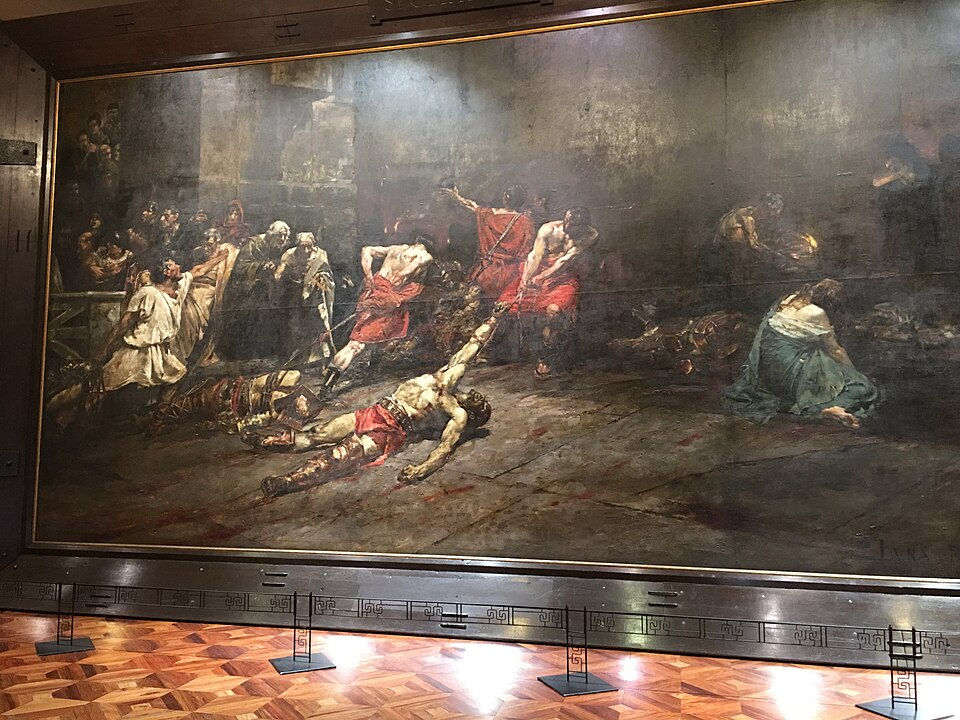
Walk into Spoliarium Hall, and it is difficult to look anywhere else. Stretching more than seven meters across, Juan Luna's Spoliarium dominates the space through sheer scale, but its power comes from more than its size. Dark figures, dramatic light, and the lifeless bodies of defeated gladiators create a scene that feels heavy with loss and human suffering.
1. Encountering Spoliarium
The painting depicts the aftermath of combat in ancient Rome. Fallen gladiators are dragged away from the arena toward the spoliarium, where their bodies were stripped of weapons and armor. Luna does not present the glory of victory. Instead, he directs attention toward those left behind after the spectacle has ended.
2. Juan Luna – A Filipino Master in Europe
Born in Badoc, Ilocos Norte, in 1857, Juan Luna studied art in Manila before continuing his training in Europe, including at Madrid's Real Academia de Bellas Artes de San Fernando. There, he developed the academic techniques, dramatic composition, and command of the human figure that would define many of his major works.
3. Triumph in Madrid
In 1884, Spoliarium received a gold medal at Madrid's Exposición Nacional de Bellas Artes. Félix Resurrección Hidalgo also received major recognition at the exhibition. Their success became a source of enormous pride among Filipino intellectuals in Europe, demonstrating that artists from the colonized Philippines could compete within Europe's prestigious cultural institutions.
4. What Does Spoliarium Mean?
Literally, the painting portrays defeated Roman gladiators. Luna did not paint an explicit scene of Spanish colonial rule in the Philippines. However, later Filipino viewers and intellectuals have interpreted the suffering, brutality, and loss within the work as resonating with the country's own experience of oppression and colonialism.
That distinction matters: its nationalist meaning grew partly through how Filipinos interpreted the painting, not simply through its Roman subject.
5. Why It Still Matters
Today, Spoliarium has become far more than an award-winning 19th-century painting. It occupies a lasting place in Philippine cultural memory, connecting artistic achievement with questions of dignity, suffering, identity, and nationhood.
For many visitors, it is where a journey through Philippine art truly begins.
The Masters Who Put Filipino Art on the World Stage
By the late 19th century, Filipino artists were beginning to gain recognition far beyond the islands. Among them, Juan Luna and Félix Resurrección Hidalgo emerged as powerful symbols of Filipino artistic achievement, earning honors in Europe while the Philippines remained under Spanish colonial rule.
1. Juan Luna – History on a Monumental Scale
Juan Luna mastered the European academic tradition, producing large historical paintings characterized by dramatic composition, carefully rendered figures, and emotional intensity. His international breakthrough came when Spoliarium received a gold medal at Madrid's 1884 Exposición Nacional de Bellas Artes. The achievement established Luna as a serious artist within European academic circles and became a celebrated moment among Filipinos abroad.
2. Félix Resurrección Hidalgo – Recognition Alongside Luna
At the same exhibition, Félix Resurrección Hidalgo received major recognition for Las Virgenes Cristianas Expuestas al Populacho. Although Spoliarium often receives greater attention today, Hidalgo's success was also central to the cultural significance of the moment.
Together, Luna and Hidalgo represented something much larger:
Filipino artists competing successfully in prestigious European exhibitions
International recognition of Filipino artistic talent
A challenge to colonial assumptions about Filipino intellectual and creative ability
A growing source of pride among Filipino intellectuals and reformists
3. The Rise of Filipino Artists
Their achievements extended beyond the art world. At a time when colonial hierarchies frequently treated Europeans as culturally superior, international recognition provided visible evidence that Filipino artists could master—and succeed within—the same institutions and traditions celebrated in Europe.
4. Art and the Emerging Filipino Nation
Filipino reformists understood the importance of that achievement. José Rizal, speaking at a Madrid banquet honoring Luna and Hidalgo in 1884, celebrated their accomplishments within a broader argument about human ability, equality, and dignity.
Their paintings did not create Filipino nationalism by themselves. But their success became intertwined with the intellectual awakening of the late 19th century, when questions of reform, equality, identity, and eventually nationhood were becoming increasingly powerful.
In this way, Luna and Hidalgo became more than successful painters. Their achievements helped show that Filipino identity could stand confidently on the world stage.
Fernando Amorsolo – Painting the Light of the Philippines
If Juan Luna's paintings often confront viewers with drama and historical struggle, Fernando Amorsolo offers another vision of the Philippines—one illuminated by sunlight, countryside landscapes, family life, and familiar moments. His paintings became some of the most recognizable images in Philippine art and helped shape how generations imagined the beauty of the Filipino countryside.
1. Master of Philippine Light
Amorsolo became celebrated for his distinctive treatment of luminous tropical light. Using backlighting and warm sunlight, he gave fields, trees, figures, and rural landscapes an almost glowing quality. Light was not merely an effect in his paintings; it became part of their emotional character.
2. Rural Philippine Life
Farmers harvesting rice, women washing clothes beside rivers, families gathering, village celebrations, and expansive landscapes repeatedly appeared in his work. These scenes elevated everyday Filipino life into subjects worthy of fine art.
His paintings frequently celebrated:
Farmers and agricultural life
Philippine landscapes and rice fields
Family and community
Traditional customs and celebrations
The beauty of ordinary rural life
3. Beauty and Idealization
Amorsolo's countryside was often idealized. His paintings emphasized harmony, abundance, beauty, and community rather than the hardships that could accompany rural life. This romantic vision helped create an enduring visual image of the Philippines, while also inviting discussion about what aspects of society were emphasized—or left outside the frame.
4. Art During War and Change
World War II dramatically altered that imagery. During the Japanese occupation and Battle of Manila, Amorsolo documented destruction, fear, displacement, and suffering. The sunlight remained, but the world he painted had changed.
5. A National Artist
In 1972, Amorsolo became the first person named National Artist of the Philippines, receiving the honor for painting. His landscapes, portraits, rural scenes, and wartime works remain essential to understanding Philippine visual culture.
Through Amorsolo, visitors encounter both an idealized Philippines and a nation transformed by history—a country painted in sunlight, but never untouched by darkness.

From Tradition to Modernism – Philippine Art Changes
Philippine art did not stop evolving with the grand historical paintings of Juan Luna or the luminous countryside of Fernando Amorsolo. As the country moved through colonial rule, war, independence, urbanization, and social change, a new generation of Filipino artists began asking a different question: How should art represent a nation that was rapidly changing?
1. Victorio Edades – Challenging the Ideal
Victorio Edades became a leading figure in Philippine modernism. Rather than emphasizing polished beauty and idealized landscapes, his work embraced heavier forms, darker tones, and subjects drawn from labor and ordinary life. His approach challenged established artistic conventions and helped open Philippine art to new possibilities.
2. Botong Francisco – Painting Filipino History
Carlos “Botong” Francisco turned toward the country's own history, traditions, and communities. Best known for large-scale murals, he transformed episodes from the Philippine past into sweeping visual narratives filled with movement and distinctly Filipino imagery.
3. Vicente Manansala and the Modern City
With Vicente Manansala, modernism moved increasingly into urban life. His distinctive approach to Cubism, often described as transparent Cubism, fragmented figures and scenes while retaining recognizable subjects. Markets, families, workers, poverty, and city neighborhoods became part of modern Philippine art.
4. Abstraction and New Visual Languages
Artists such as Hernando Ocampo pushed even further toward abstraction, using shape, rhythm, and color to express ideas beyond conventional realism. Meanwhile, sculptors such as Guillermo Tolentino demonstrated how classical artistic traditions could be used to represent Filipino heroes, history, and national identity.
Across these generations, Philippine art expanded to embrace:
Modernism and abstraction
Cubism and experimentation
Urban and working-class life
Social realities
Philippine history and folklore
War, independence, and postwar identity
The result was not the disappearance of tradition, but a widening of possibilities.
As visitors move through the museum, they can see Filipino artists repeatedly redefining what Philippine art could be—searching for new visual languages to express a country continually redefining itself.
More Than Paintings – Exploring the Collection
While Spoliarium and the works of celebrated Filipino painters naturally attract attention, the National Museum of Fine Arts offers a much broader view of Philippine creativity. Its collections reveal how Filipino artists have worked across different materials, techniques, and traditions to express faith, history, identity, and social change.
1. Sculpture – Stories in Three Dimensions
Philippine sculpture ranges from religious and classical forms to modern experimentation. Works associated with important sculptors, including Guillermo Tolentino and other influential Filipino artists, demonstrate how stone, wood, metal, and other materials became vehicles for portraiture, symbolism, and national memory.
2. Drawings and Prints – Art Beyond the Canvas
Drawings, sketches, studies, and prints provide another perspective on artistic creation. Some reveal the planning behind larger works, while others stand independently as expressions of observation, experimentation, and everyday life.
3. Religious and Colonial Art
Centuries of Christianity and Spanish colonial influence left a deep imprint on Philippine visual culture. Religious imagery and colonial-era works reveal how European traditions were introduced, adapted, and transformed within a Filipino setting.
4. Modern and Contemporary Perspectives
As Philippine society changed, artists increasingly experimented with abstraction, modernism, social commentary, and new approaches to Filipino identity. These works demonstrate that Philippine art has never remained static.
5. Documents, Memorabilia, and Artistic Context
Historical documents, photographs, studies, and memorabilia help visitors understand the people behind the artworks and the periods in which they lived.
Together, these collections remind visitors that Philippine art cannot be represented by a single masterpiece or style. From sculpture and sketches to religious imagery and modern experimentation, the museum tells a much larger story of Filipino creativity.
Visiting the National Museum of Fine Arts
A visit to the National Museum of Fine Arts is one of the easiest ways to experience Philippine history, culture, and art while exploring Manila. Its central location also makes it convenient to combine with Rizal Park, Intramuros, and other nearby historical attractions.
Location
Address: Padre Burgos Avenue, Ermita, Manila
Area: Beside Rizal Park
Nearby landmarks: Rizal Park, Intramuros, Manila City Hall, and the other National Museum buildings
Best for: Art lovers, history enthusiasts, families, students, and first-time Manila visitors
Opening Hours and Admission
As of 2026:
Opening hours: 9:00 AM–6:00 PM daily
General admission: Free
Walk-in visitors: Welcome
Large groups: Groups of 20 or more should arrange an advance booking
Before visiting: Check the National Museum's official website for current schedules, closures, and visitor policies
How to Get There
Taxi or ride-hailing: One of the simplest options for travelers unfamiliar with Manila.
Public transportation: Buses, jeepneys, and rail connections serve the Ermita and Rizal Park area.
Walking: Travelers already exploring Rizal Park or nearby historic Manila can incorporate the museum into a walking itinerary.
From Intramuros: The museum is close enough to combine both areas into the same sightseeing day.
How Long Should You Spend?
Plan approximately:
1–2 hours for major highlights
2–3 hours for a comfortable general visit
3+ hours for art and history enthusiasts who want to explore the galleries in greater detail
Tips for a Better Visit
Begin with Juan Luna's Spoliarium.
Don't limit your visit to the museum's most famous masterpiece.
Read the exhibition descriptions for historical context.
Explore works by Luna, Hidalgo, Amorsolo, Manansala, Botong Francisco, and other Filipino artists.
Allow time for the historic Old Senate Session Hall.
Wear comfortable shoes—the museum is extensive.
Respect current photography and gallery restrictions.
Avoid rushing from room to room.
Consider visiting the nearby National Museum of Anthropology and National Museum of Natural History if time allows.
The National Museum of Fine Arts rewards curiosity. Slow down, look beyond the famous masterpieces, and allow the galleries to take you through different chapters of the Filipino story.
Takeaway – Seeing the Philippines Through Filipino Eyes
Stand quietly before a painting in the National Museum of Fine Arts, and for a moment, the distance between past and present begins to disappear. You are no longer simply looking at Philippine history—you are seeing how someone who lived through a different time chose to remember it.
Many visitors may come first for Juan Luna's Spoliarium. But beyond its enormous canvas lies an even larger story. There is Luna's historical drama, Amorsolo's sunlight, the bold experiments of Filipino modernists, and generations of artists who turned war, family, faith, inequality, everyday life, identity, and social change into art.
Together, their works remind us that the Philippines cannot be understood through a single image or story.
To truly know the country, travel beyond its beaches, islands, waterfalls, and famous landmarks. Walk through its historic streets. Listen to its people. Learn its history. Experience its traditions.
And sometimes, simply stand before a canvas and see the Philippines through the eyes of those who painted it.
Frequently Asked Questions
Where is the National Museum of Fine Arts?
The National Museum of Fine Arts is located along Padre Burgos Drive in Rizal Park, Manila. Its central location makes it easy to combine with Rizal Park, Intramuros, and other historical attractions.
Is the National Museum of Fine Arts free?
Yes. General admission is currently free, making the museum one of Manila's most accessible major cultural attractions. Visitors should check the National Museum's official information before traveling in case policies or schedules change.
What is the most famous painting in the National Museum of Fine Arts?
The museum's best-known masterpiece is Spoliarium by Juan Luna, one of the most celebrated works in Philippine art.
Where is Juan Luna's Spoliarium displayed?
Spoliarium is displayed in the museum's Spoliarium Hall, where it shares the space with other significant works of Philippine art.
Can you take photographs inside the museum?
Yes. Current visitor guidelines allow photography inside the museum, but camera flash is prohibited. Commercial photography and organized photo shoots require prior approval.
Is the National Museum of Fine Arts worth visiting?
For travelers interested in Philippine history, art, architecture, and culture, the museum offers an opportunity to experience centuries of Filipino creativity within one historic building.
What is the history of the National Museum building?
The building was constructed between 1918 and 1926, originally planned as a National Library before becoming the Legislative Building. Severely damaged during the Battle of Manila in 1945, it was later reconstructed and eventually became part of the National Museum complex.
What other National Museums can you visit nearby?
Visitors can continue exploring the National Museum complex at the nearby National Museum of Anthropology and National Museum of Natural History, making it possible to experience Philippine art, culture, archaeology, biodiversity, and natural heritage in the same area.

Festivals Philippines: An Adult Coloring Book
Celebrates the vibrant spirit of the Philippines through detailed illustrations inspired by colorful festivals, traditional costumes, cultural masks, folk dancers, lanterns, and tribal patterns. This coloring book offers a relaxing and creative journey into the rich culture, traditions, and festive energy of the Philippine islands.



Comments